Background
Ethiopian Economy is mainly dependent on the agricultural sector and the country’s future development is believed to continue being heavily dependent on this sector. To make the best use of the driving sector, efficient and effective mobilization, and utilization of agricultural resources is paramount. In spite of the salient roles that the agriculture sector plays in the national economy and the huge potential of the country has for agricultural development, the performance of the sector is not yet satisfactory. As a result of the very low productivity of the sector, its roles in capital formation, supply of raw materials to industries, generation of foreign currency, ensuring food security and offering of fertile market to local produces and services remain underplayed. In fact, significant portion of the population of the country is below the internationally defined poverty line with more severity in rural areas. However, in recent years, some progresses are seen in the productivity of the sector as a result of various efforts made to use productive technologies, extensive cluster farming activities and the development of private agricultural enterprises.
Over the past three decades the Ethiopian government has adopted various economic policy reforms namely: The Agricultural Development Led Industrialization (ADLI), Accelerated and Sustainable Development to End Poverty (PASDEP) , Growth and Transformation Plan I and II (GTP I and II), and currently, Home-Grown Reform and the Ten-Years Strategic plan targeting to propel the country‟s economic progress. In all these strategies the government has identified the priority areas as agricultural and rural development, infrastructural development and capacity building.
With the advent of 1994 Education and Training Policy (ETP), the education sector has passed through successive rolling Education Sector Development Programs (ESDP I-V). To achieve its vision of becoming a lower middle income by 2030, the ten years perspective plan also gives due consideration for development of skilled and competent manpower.
The new Higher Education Policy and Strategy provides key changes such as renovating curriculum, teaching method, assessment and student support for enhanced student experience and performance. It includes merit-based appointments and career progression based on teaching, research and service. The policy commends establishment of a National Science and Research Foundation to fund outstanding peer-reviewed research and scientific investigations as well as appointment of high qualified independent boards having academic and administrative autonomy. In terms of access and equity, a range of measures including greater opportunities for outstanding public education; scholarships by private universities for special needs and underprivileged students and using different educational provision modalities such as online education, and continuing and open distance learning are among few important initiatives. Equipping higher education institutions with infrastructures and facilities to provide quality education to learners, strengthening a quality assurance system, and making higher education flexible to take courses of students‟ choices are important aspects of HE changes. Overall, based on the differentiation of universities, there will be a competitive research and technology transfer budget award for the execution of mega projects which can solve prioritized national problems.
The role of the private sector has shown a significant leap in reply to the favorable investment policy and various external opportunities offered through the New Economic Partnership for Africa‟s Development (NEPAD), the African Growth and Opportunity Act (AGOA) and the bilateral agreements the government entered with many countries. In all cases, agriculture has remained a priority area of investment. In line with this, the demand for qualified personnel in various fields steadily rises in the labour market. In particular, the currently flourishing agricultural enterprise, the banks, micro-finance institutions, cooperative societies, and farmers unions, the agro-industries, input suppliers and marketers of agricultural products at home or abroad, the research institutes, and training institutions have faced problems of qualified human power from local markets. Some have imported staff from other countries at very high cost just to fill the gap.
The Department of Agricultural Economics is the oldest departments in the Ethiopian Higher Education. It was among the pioneer sections at Haramaya University, the then Alemaya
University, commenced in 1960 to produce qualified BSc graduates in Agricultural Economics. The first graduates were only three in 1962. Currently, the program is being run by various higher learning institutions at different levels of qualifications. The program has been making its own contribution to the development efforts through producing skilled and competent professionals, in areas such as socioeconomic research and development, agricultural marketing, agricultural entrepreneurship, policy analysis. On top of these, there is a very wide international reputation and significance of the program all over the world.
Rationale of the Program
Due to globalization, individuals in the world are now opting for food and fiber coming from developing countries because of the organic nature the produces and their comparative advantage in production. To make use of this opportunity, Ethiopia has to be competent in the global market by producing high quality agricultural products at a competitive price. To this effect, competent human resource in the areas of optimizing scarce resource use, planning profitable projects which accelerate the pace of production and productivity is unquestionable. Hence, producing skill manpower capable, competent graduates in the field of Agricultural Economics is instrumental.
Promoting growth and sustainable development in Ethiopia demands competent and committed professionals. Accordingly, the Ethiopian Government revised the entire education system and launched a new road map in 2019. As a result, the three years BSc in Agricultural Economics Program will run for four years starting from 2020/21 academic year. This necessitates revision of the nationally harmonized curriculum of the program. As per the directives given by MOSHE, Haramaya University was given the task to lead the curriculum revision program under the college of Agriculture. As part parcel of the college, the School of Agricultural Economics and Agribusiness, Haramaya University took the lead in revising curriculums of BSc in Agricultural Economics and BSC in Agribusiness and Value Chain Management programs. Jima University served as a major reviewer throughout the process. In addition, various stakeholders and higher learning institutes were involved in the revision starting from the course catalog preparation stage.
It is unquestionable that a standard and harmonized curriculum that enables higher learning institutes to produce qualified and capable professionals to enhance the socio-economic development of the country is mandatory. Therefore the revision was made to make the program competency based, market oriented and more practical. To make graduates competent in the region as well as internationally, various accredited regional programs and curriculums were considered.
Program Objectives
The overall goal of the B.Sc. degree program is to produce competent, skilled, and committed agricultural economics professionals capable of bringing change in the agricultural economy.
The specific objectives of this academic program are to:
Produce knowledgeable graduates in the field of Agricultural Economics who can assist efficient and sustainable use of the societies‟ scarce resources;
Produce committed, motivated, socially accountable and qualified Agricultural Economists who undertake problem-solving socio-economic researches in the field;
Produce graduates who will engage in community services, and
Provide consultancy and advisory services to governmental and/or non-governmental organizations
Graduate (Professional) Profile
The intended graduate of Agricultural Economics is generally capable to develop economic information on farm production methods and technologies. He/she can analyse and evaluate linkages of production with processing, distribution and final consumer demand. The graduate is also an expert in understanding and interpreting the linkages between: agriculture and the environment; agribusiness and consumers and decision-maker; and prepare dynamic careers in business, natural resources, and the environment & economics interaction. The curriculum has been designed in a way that combines economics and agricultural fundamentals with insights into the dynamic social, technological and environmental forces that shape production and marketing decisions.
After successful completion of the training, the graduates are expected to gain knowledge skills and attitude that enable them to:
Participate in design, implementation and evaluation of agricultural development projects;
Apply effective and efficient resource utilization theories and practices for sustainable agricultural development;
Involve in feasibility studies and advise investors, financial institutions, agriculture and allied sectors;
Assist researchers and policy makers in agricultural production and productivity; marketing and sustainable use of natural resource and environment;
Establish and operate their own business;
Train and advise small scale farmers and agricultural entrepreneurs;
Serve as planners in agricultural offices;
Manage small scale farms and agricultural enterprises;
Work as Extension team member/leader, Market expert and Loan officer; and
Assist teaching at Higher Learning, technical and vocational training institutions.
1.6 Program Profile
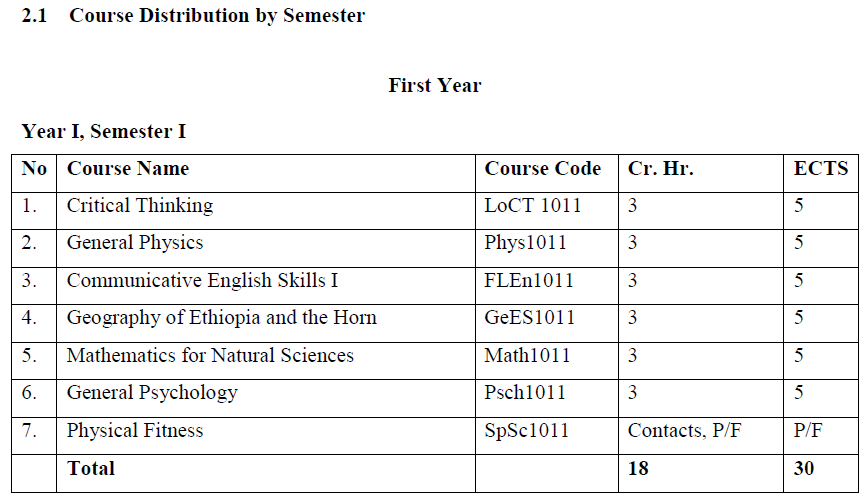
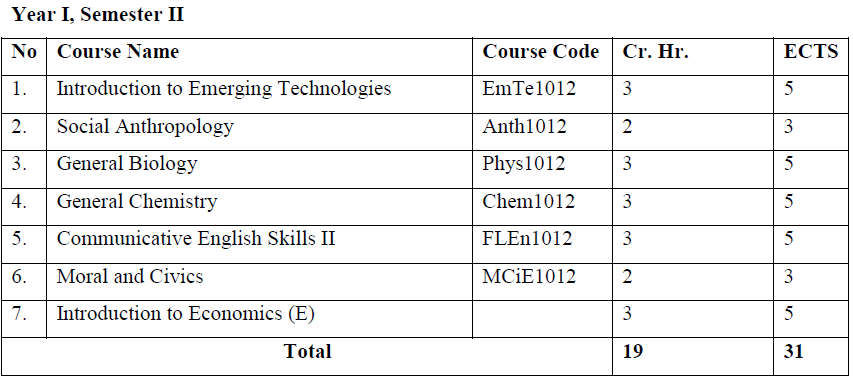
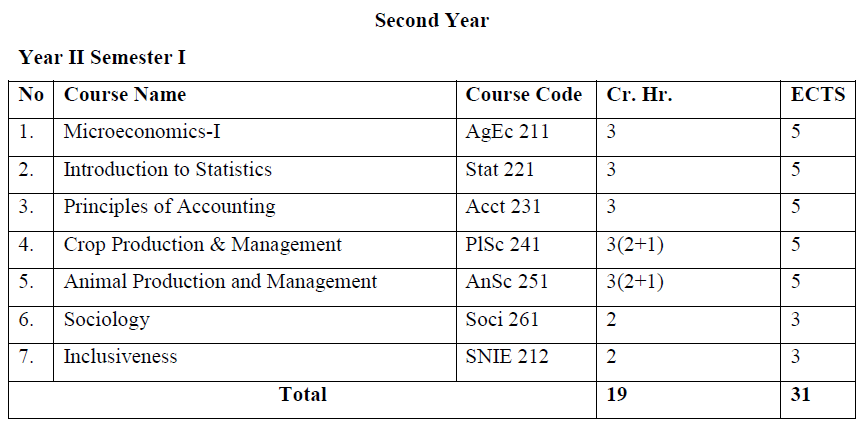
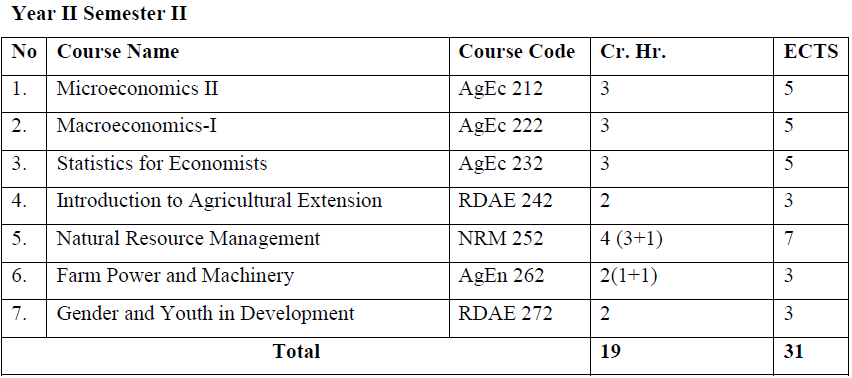
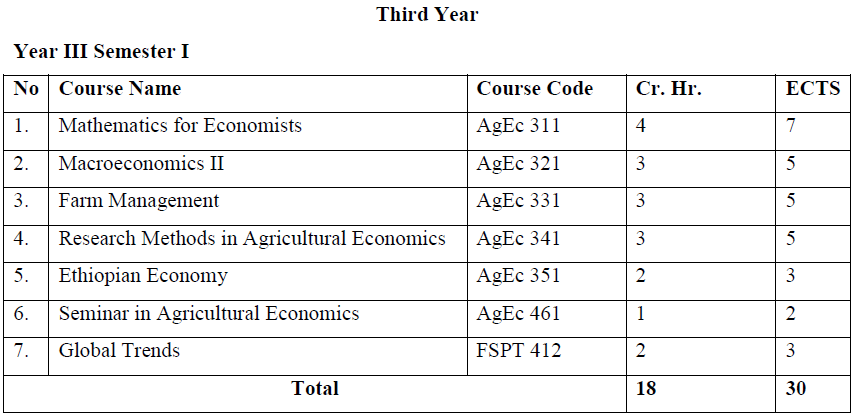
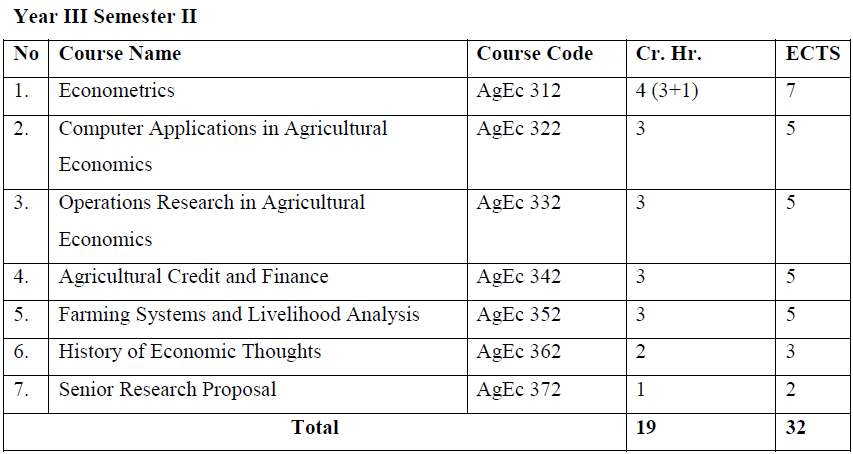
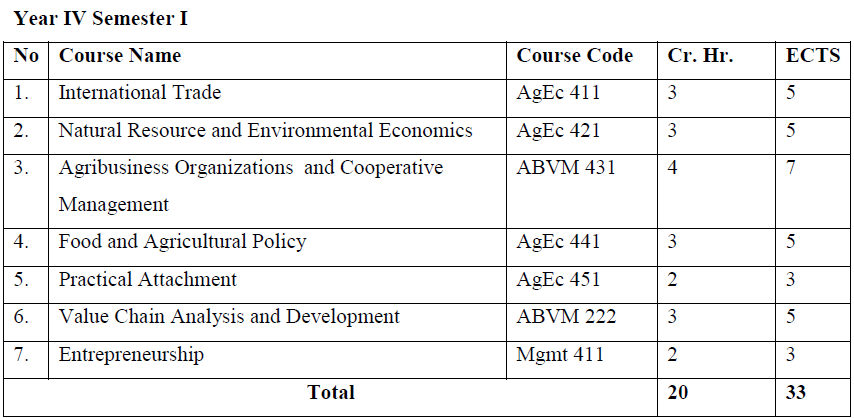
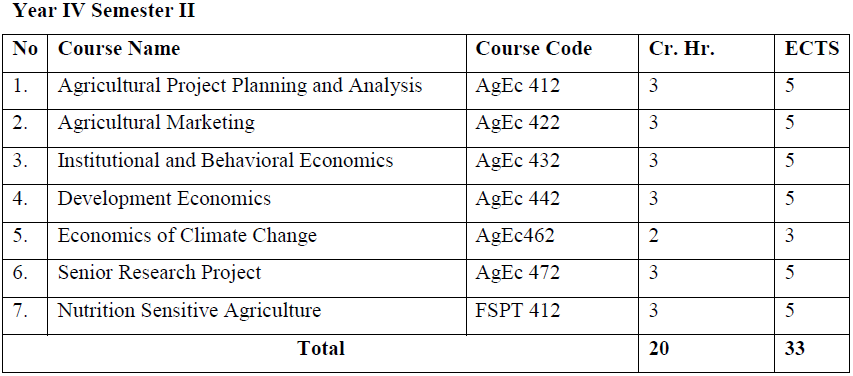
The training is a four years program. It offers theoretical knowledge and practical skills to qualify the students for the intended professional profile. Students are required to take a total of 152 credit hours or 251 ECTS
1.6.1 Duration of the Degree Program
A four-year academic time is required to acquire a Bachelor of Science (B.Sc.) degree in Agricultural Economics. Students will join the program after successfully completing first year common courses. Since the program is a multidisciplinary and reasonably quantitative, students should have a strong background in mathematics.
1.6.2 Admission Requirements
Students admitted directly from secondary school are required to meet the national higher education enrollment criteria of that year. After successfully completing first year common courses, students will join the program competitively based on their interest, grade point of the first year and performance in quantitative courses. Others like re-admission and advance standing shall be treated according to the academic rules and regulations of the Universities.
1.6.3 Graduation Requirements
Students who are directly admitted from secondary school are expected to take a total of 152 credit hours (56 courses). At the end of the program, the student is required to have a Cumulative Grade Point Average (CGPA) of 2.00 with no “F” letter grade in any course.
1.6.4 Degree Nomenclature
Students who have successfully completed graduation requirements can earn the following degree: Bachelor of Science (B.Sc.) degree in Agricultural Economics. Its Amharic version is “የሳይንስ ባችለር ዲግሪ በ ግብርና ምጣኔ ሐብት”